
2026–2027 Knitwear Color Trends for Women’s Fashion Brands in Europe
1. Why Color Matters More in Fast Fashion Knitwear
2. Two Key Color Directions for 2026–2027 Women’s Knitwear in Europe
- 2.1 Commercial Safe Colors for Core Collections
- 2.2 High-Impact Colors for Fashion-Driven Collections
3. The Real Challenge for Fast Fashion Brands
4. Manufacturing Perspective: Why Consistency Matters
How Color Selection Impacts Sell-Through Performance in Fast Fashion Knitwear
In the fast fashion knitwear industry, color selection has become one of the most important factors influencing product success in retail.
For many European womenswear brands, a common issue continues to appear:
A sweater may look perfect during sampling, but fail to achieve strong sell-through in bulk production.
This gap is not always related to design quality. In many cases, it is related to how colors perform in real retail environments.
1. Why Color Matters More in Fast Fashion Knitwear
In fast fashion, product success depends heavily on:
- visual impact in stores and online platforms
- emotional response from consumers
- repeat purchase potential
- alignment with seasonal trends
Unlike design elements that change slowly, color is one of the fastest-changing decision factors in buying behavior.
A small difference in tone can significantly impact whether a product becomes a bestseller or a slow-moving item.
2. Two Key Color Directions for 2026–2027 Women’s Knitwear in Europe
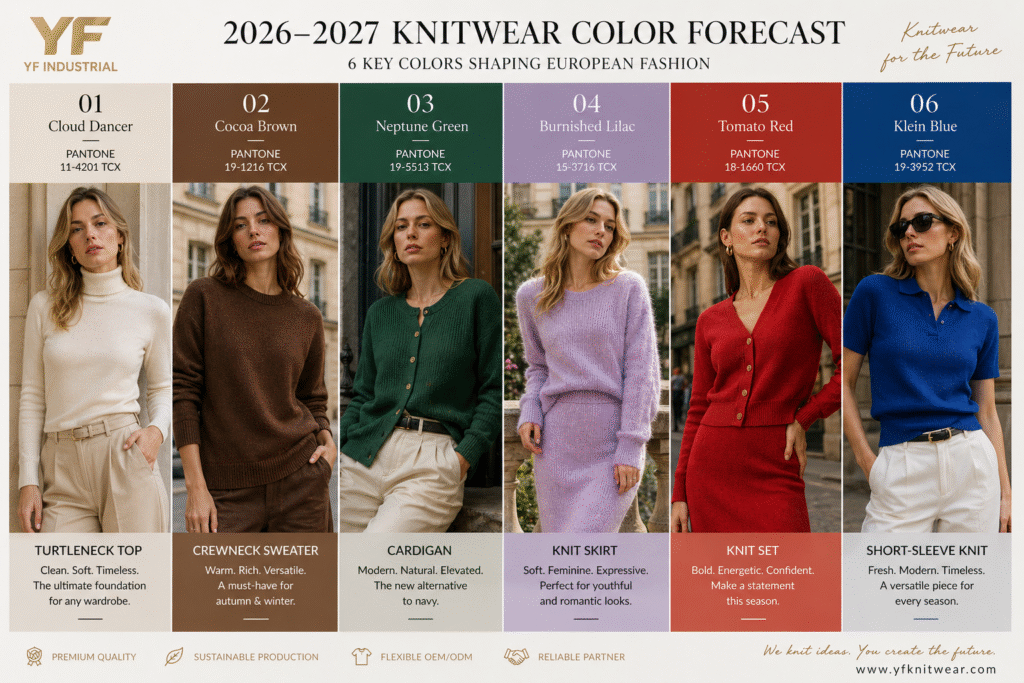
Based on sourcing feedback from European fashion buyers and production experience in knitwear manufacturing, we observe two clear directions:
2.1 Commercial Safe Colors for Core Collections
These colors are widely used in stable, high-reorder knitwear programs:
- Cloud Dancer (11-4201 TCX)
- Cocoa Brown (19-1216 TCX)
- Klein Blue (19-3952 TCX)
These shades are typically used for:
- basic knitwear collections
- long-term repeat orders
- high-volume retail programs
They offer stability in both production and retail performance.
2.2 High-Impact Colors for Fashion-Driven Collections
These colors are designed for attention and trend-driven sales:
- Burnished Lilac (15-3716 TCX)
- Tomato Red (18-1660 TCX)
- Neptune Green (approx. 19-5513 TCX)
These shades are commonly used for:
- social media-driven collections
- seasonal statement pieces
- window display products
They help brands increase visibility and engagement in competitive retail environments.
3. The Real Challenge for Fast Fashion Brands
The main challenge is not simply choosing fashionable colors.
It is balancing three key factors:
- speed of trend reaction
- stability of bulk production
- sell-through performance in retail
Many brands face difficulties when a color performs well in sampling but does not maintain consistency or demand in bulk production.
4. Manufacturing Perspective: Why Consistency Matters
In knitwear production, color performance depends on multiple technical factors, including:
- yarn dye stability
- batch-to-batch color consistency
- sample-to-bulk reproduction accuracy
- fabric structure and fiber composition
Without proper control, even approved colors may vary significantly in final production.
This is one of the most common reasons behind discrepancies between sampling results and retail performance.
5. How YF Industrial Supports Color Execution for Brands
At YF Industrial, a knitwear manufacturer with over 13 years of export experience, we support European fashion brands by focusing on production reliability and color consistency.
Our approach includes:
- strict yarn and dyeing control before bulk production
- sample-to-bulk color matching verification
- fast sampling development within 7 days
- flexible low MOQ starting from 200 pcs per color
This helps fast fashion and womenswear brands reduce production risks and improve consistency from sampling to final delivery.
Conclusion
Color selection in knitwear is no longer just a design decision.
It is a commercial decision that directly affects retail performance and inventory success.
For 2026–2027, successful womenswear brands will need to balance:
- safe commercial colors for stable revenue
- high-impact colors for brand visibility
Understanding this balance is key to building successful knitwear collections in the European market.