
Low MOQ Knitwear for Fast Growing Fashion Brands: How to Launch Collections Without Heavy Inventory
1. Most growing brands don’t have a design problem — they have a production problem
2. Low MOQ is not about quantity — it’s about how you build your collection
3. Why fast growing brands are shifting to low MOQ production
4. What works best in low MOQ knitwear production
5. How we support low MOQ knitwear projects at YF
1.Most growing brands don’t have a design problem — they have a production problem
Most fast growing fashion brands we work with already have strong design ideas.
The real challenge usually comes later:
how to turn those ideas into a full collection without overproducing inventory.
At YF, we see this situation every day from brands expanding from online stores to multi-channel retail.
They don’t want to gamble on large production volumes anymore.
They want something more practical:
- faster product testing
- controlled inventory
- flexible seasonal drops
- stable reorders when styles perform well
That’s exactly where low MOQ knitwear production becomes useful.
But low MOQ is not just “small quantity production.”
It’s a different way of planning collections.
2.Low MOQ is not about quantity — it’s about how you build your collection
Many buyers think MOQ is just a number.
In knitwear production, it’s not that simple.
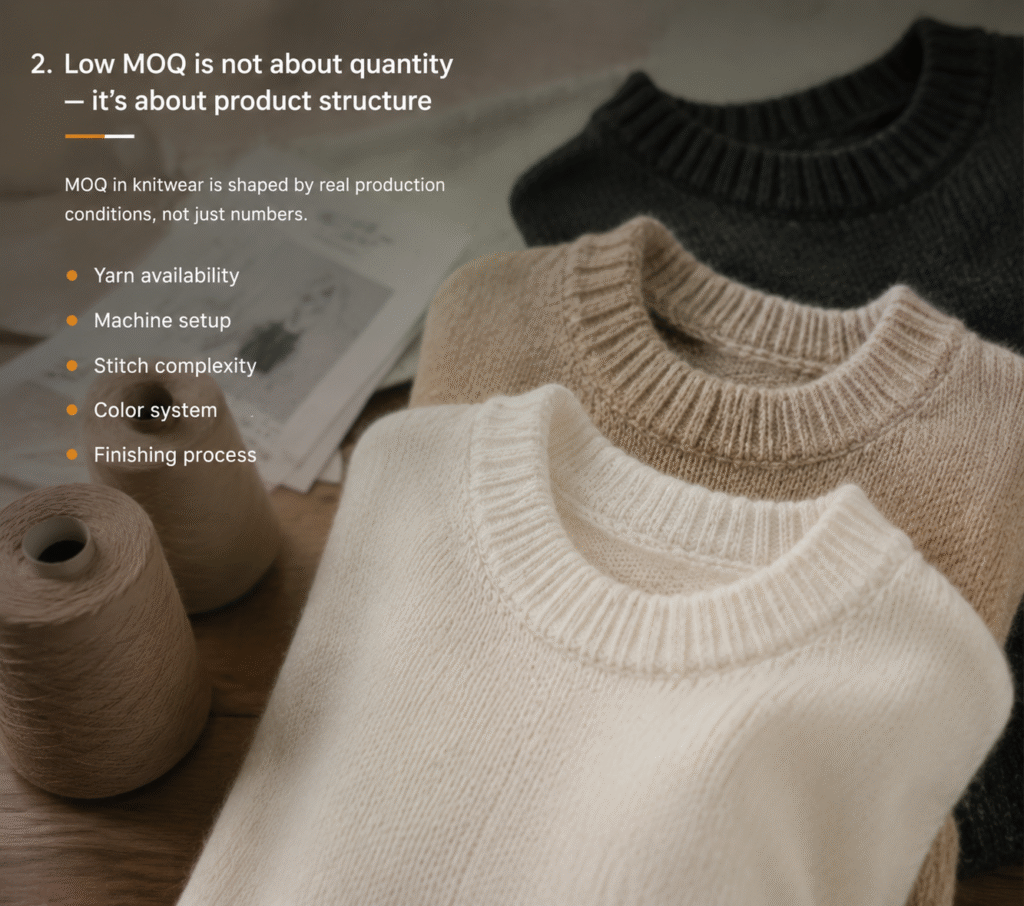
MOQ is shaped by real production conditions:
- yarn availability
- knitting machine setup
- stitch complexity
- color system
- finishing process
For example, a simple sweater made with stock yarn can be produced in relatively small batches.
But once you add:
- custom dyed yarn
- multiple colorways in one style
- complex stitch structures
- heavy detailing or embroidery
the production setup changes completely.
So in reality, low MOQ is not just a purchasing option.
It’s about how the product is designed from the beginning.
3. Why fast growing brands are shifting to low MOQ production
For growing fashion brands, low MOQ is not about “starting small.”
It’s about working in a faster product cycle.
We usually see brands using low MOQ to:
- test new categories before scaling
- launch seasonal capsules faster
- reduce stock pressure across SKUs
- adjust designs based on real market feedback
- expand collections step by step instead of all at once
Instead of producing one big batch, many brands now prefer smaller runs like:
80–200 pieces per style for initial testing.
This allows them to see what actually works in the market before committing to larger production.
4. What works best in low MOQ knitwear production
From our experience at YF, low MOQ works best when the first collection is kept focused and production-friendly.
Some practical approaches include:
- limiting colorways in the first production run
- keeping stitch structures clean and stable
- using reliable yarn systems instead of highly experimental materials
- focusing first on fit, silhouette, and wearability
- introducing heavy detailing only after market validation
This doesn’t reduce creativity.
It actually makes it easier to scale later.
Because once a style performs well, reorders become faster and more stable.
5. How we support low MOQ knitwear projects at YF
At YF, we don’t treat low MOQ as “reduced production scale.”
We treat it as early-stage collection development.
In many projects, we help brands:
- adjust yarn selection for production stability
- simplify construction to reduce sampling risk
- improve sample consistency before bulk production
- plan reorder structure based on performance feedback
- balance design intent with production feasibility
Our goal is simple:
help brands launch faster without creating scaling problems later.
Because in knitwear, instability in early production usually becomes expensive later.
6. Common mistakes we see from new collections
Most production issues are not caused by factories.
They usually come from early product decisions.
A few common ones:
- too many colors in the first launch
- overly complex knitting structures too early
- unclear sizing strategy before sampling
- expecting bulk pricing at very low quantities
- skipping testing phase and going straight into large production
Low MOQ only works well when expectations match production reality.
7. Final thoughts
Low MOQ knitwear production is not just a sourcing option.
For fast growing fashion brands, it’s a way to build collections in a more controlled and flexible way.
Instead of launching everything at once, brands can now:
test → adjust → reorder → scale
in a much more efficient cycle.
If you are developing a new knitwear collection, we can help evaluate your designs and suggest the most practical way to start production with low MOQ.